Each covers dividends, interest, and royalties
Governed treaty pre-review
Turn cross-border payments into governed treaty review packages.
Convert payment facts into a controlled treaty lane, preliminary withholding ceiling, evidence trail, document agenda, business follow-up, and reviewer sign-off record.
AI structures intake and review preparation. Treaty conclusions stay source-grounded, bounded, and human-controlled.
10 China treaty pairs
Dividends, interest, royalties
Source-grounded review trail
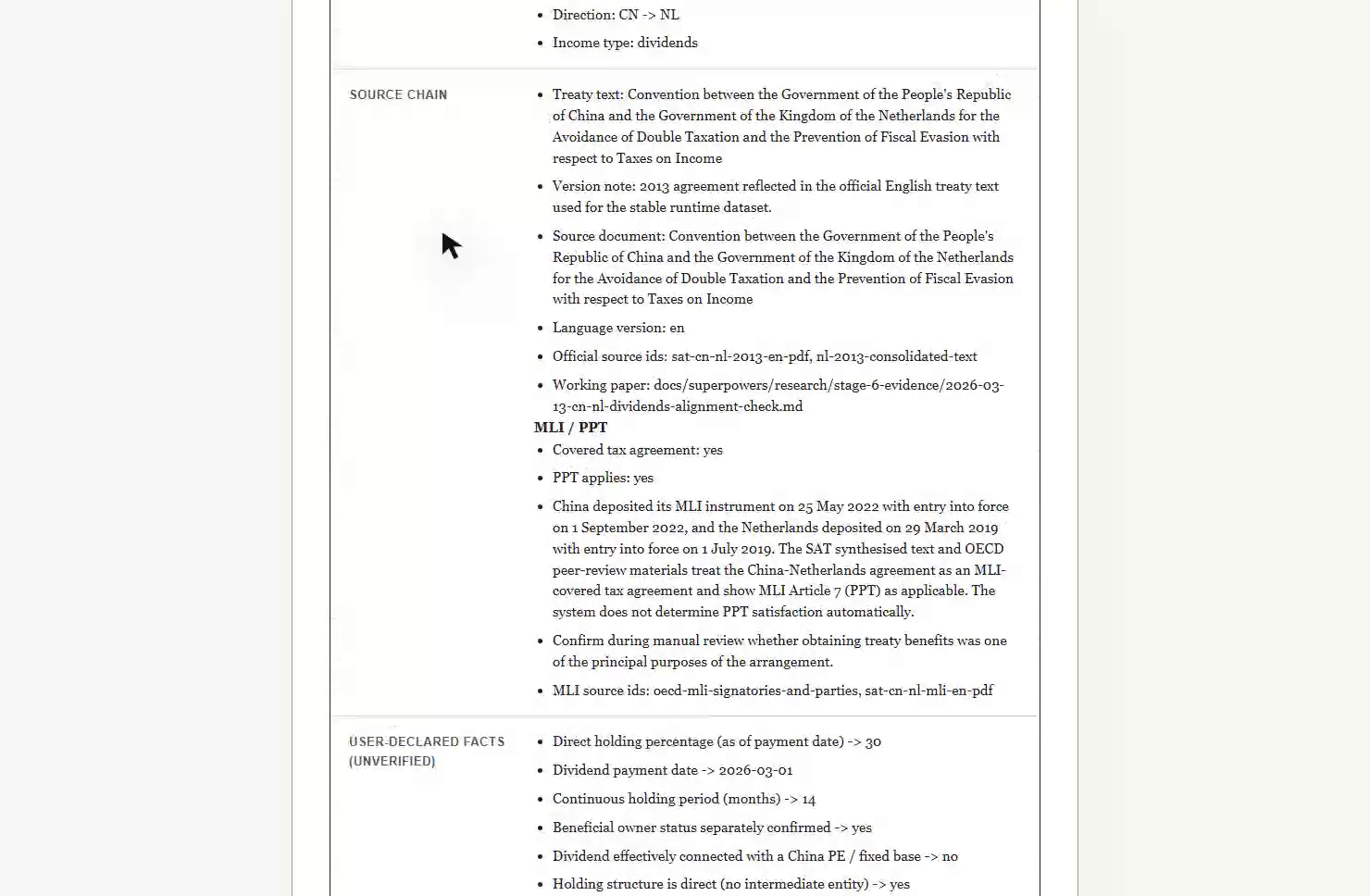
Source chain, user facts, BO, MLI/PPT, verification items, and human judgment are acknowledged before closure
Review architecture
Review infrastructure, not prompt-and-answer tax chat.
The higher-value layer is not a longer answer. It is a governed path from payment facts to treaty position, evidence trail, open issues, and a record another reviewer can rely on.
Starting point
Prompt-based tax Q&A
A natural-language question and a set of retrieved results
Tax Treaty Agent
Guided payment facts that narrow the case to a governed treaty lane
Reasoning boundary
Prompt-based tax Q&A
The model keeps synthesizing until the answer looks complete
Tax Treaty Agent
The workflow stays inside defined review states, refusal paths, and escalation points
Evidence discipline
Prompt-based tax Q&A
Evidence quality shifts with prompt phrasing, retrieval results, and page availability
Tax Treaty Agent
Treaty logic stays tied to structured sources, source chain, and working-paper lineage.
Output artifact
Prompt-based tax Q&A
A plausible narrative answer
Tax Treaty Agent
A reviewer package with review state, evidence, next actions, and handoff context
Learning loop
Prompt-based tax Q&A
Reviewer corrections disappear when the session ends
Tax Treaty Agent
Final decisions, machine-vs-human deltas, similar cases, and policy overlays feed the next review
International tax review fails when a confident answer outruns its facts. This product is designed to slow the answer down into evidence, action items, and accountable sign-off.
Evidence and governance
Evidence before assertion. Governance before output.
The public proof is no longer only that treaties can be compiled. It is that a payment can become a reviewable, auditable, human-controlled work record.
Proof matrix
Compiler proof across five lanes
- CN-SG shadow rebuild
- CN-NL shadow rebuild
- CN-SG OECD delta proof
- CN-NL OECD delta proof
- CN-KR initial onboarding
The compiler path already spans shadow rebuilds, OECD delta proofs, and one real new-pair onboarding lane.
Governed review checkpoint
Final decisions now require explicit reviewer sign-off
Sign-off gate
A reviewer must acknowledge source chain, user facts, verification items, BO, MLI/PPT, and human judgment before closing a case.
Structured final decision
Saved case, workpaper, and internal detail preserve the final ruling, reason, and history.
Machine vs. human delta
The gap between the machine draft and human decision stays on the case record.
Reviewer memory
Similar cases and policy overlays carry forward into the next review.
This moves the product from a one-time machine draft toward a durable, accountable review record.
Measured pilot
Measured CN-KR onboarding reference
Reviewer elapsed
26 seconds
End-to-end elapsed
10m45s
Reference mode
Governed official inputs
Measured on governed official inputs. This is single controlled pilot evidence, not a general onboarding SLA.
90-second case walkthrough
A real CN–NL dividend case, from intake to review boundary.
The walkthrough shows the product operating as a review system: guided intake, treaty branch, source chain, reviewer package, and a clear stop before final determination.
CN -> NL dividends
Input
Select a supported treaty pair and income type
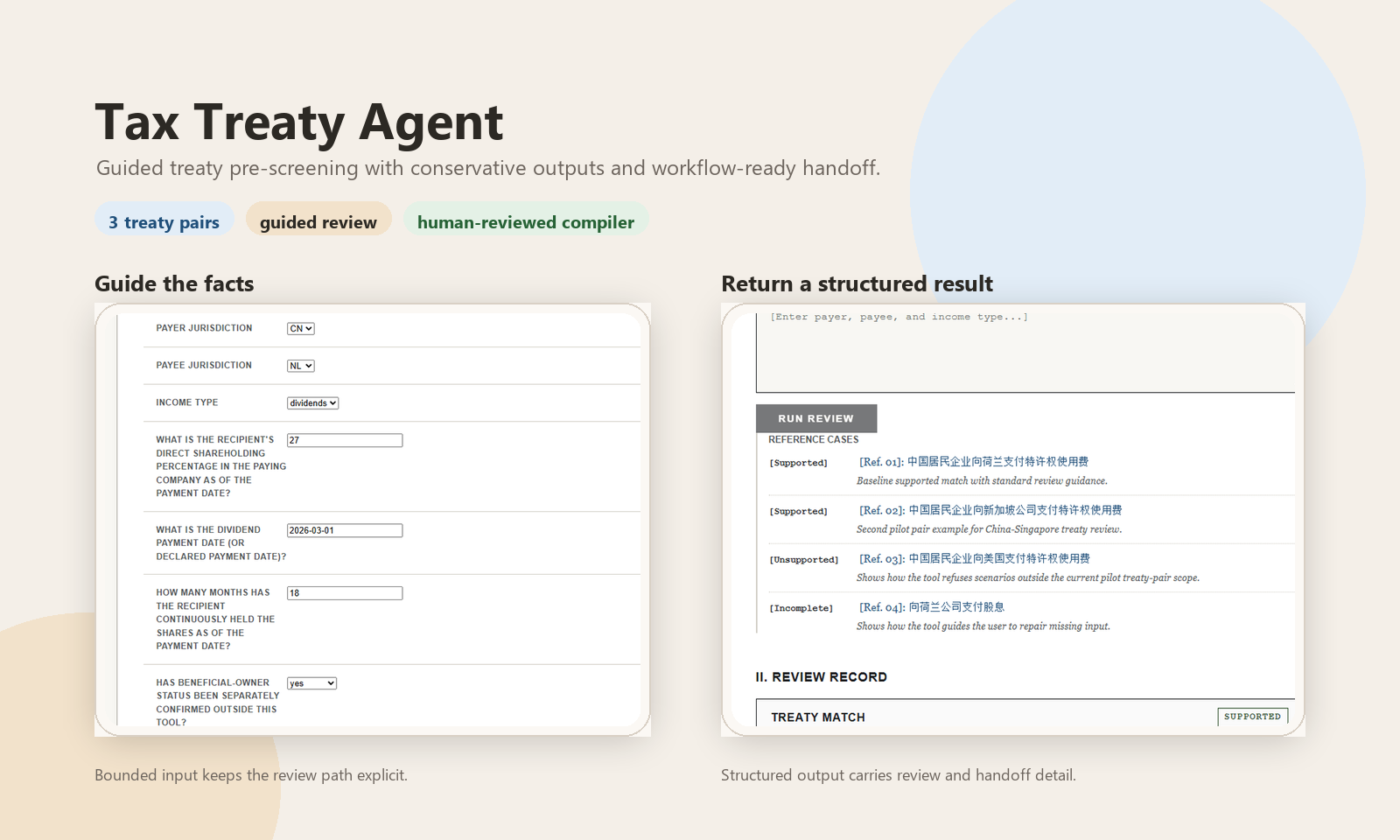
Guided facts
Focus on the fields that determine the dividend path — not a full-page scan
Treaty branch
Stop at the branch that narrows the case to Article 10
Source chain
The longest stop: the sources behind the branch, not just a rate conclusion
Handoff package
Confirm the workflow-ready package for the next reviewer
Final boundary
Land on the boundary explicitly: this is a review record — escalation to a final determination is required
Reviewer-grade output
A reviewer-grade payment package, not a one-off answer.
The useful artifact is not polished prose. It is a portable case package that can move to business, finance, internal tax, or the next reviewer.
- Tax treatment conclusion card Income type, treaty lane, preliminary rate ceiling, support status, and boundary note stay together.
- Missing documents and business follow-up BO, PPT, and document-consistency issues become concrete facts or files to collect next.
- Final decision with sign-off The reviewer must complete key acknowledgements before saving the structured final decision.
- Case memory and policy overlays Similar cases, recurring missing facts, and policy overlays are available in the next review.
Controlled treaty onboarding
From official source text to governed runtime data.
New treaties are not assembled by a live agent searching the web. They enter through a controlled offline compiler that compares bilateral Articles 10, 11, and 12 against the OECD Model baseline, produces a structured candidate dataset, and waits for human review before runtime promotion.
01 · Baseline-aware delta extraction
The offline authoring pipeline compares bilateral treaty text against OECD Model 2017 Articles 10/11/12, producing delta artifacts and a complete runtime candidate dataset.
02 · Human review remains a hard gate
Compiled output does not go live automatically. Review, approval, and promotion are discrete steps. Tax judgment stays under human control.
03 · One real CN–KR onboarding reference already exists
A verifiable CN–KR onboarding run is preserved in the repo. This is not an abstract description of a future capability.
Coverage and boundaries
Expanded coverage, governed by explicit boundaries.
The runtime now covers 10 China treaty pairs. Each path remains limited to dividends, interest, and royalties.
Proofed treaty pairs
China - Netherlands, China - Singapore, China - Korea
Promoted runtime pairs
China - Australia, Canada, Ireland, Japan, New Zealand, United Kingdom, United States
Income lanes
Dividends, interest, royalties
Boundaries
This tool does not replace a final tax opinion
It produces a governed first-pass review record. Final legal or tax determination remains with the human reviewer.
- Not a final determination The output is a first-pass review record, not a substitute for legal, tax, or internal approval.
- MLI/PPT stays a review signal The product surfaces these issues for human follow-up instead of pretending to resolve them automatically.
- Unsupported scope is rejected When a case falls outside the supported treaty pairs or lanes, the workflow says so directly.
Executive verifier path
Verify the product story in three minutes.
If you only have a few minutes, check the workflow architecture, watch one real case, then scan the proof layer.
01 · Start with the architecture
See why the product is positioned as review infrastructure instead of a search-and-summarize tax answer.
02 · Watch the 90-second demo
Follow a real CN–NL dividend case from input to final boundary.
03 · Scan the evidence layer
Confirm that compiler proof, reviewer sign-off, reviewer memory, and runtime boundaries land on concrete evidence.